tribe bovini
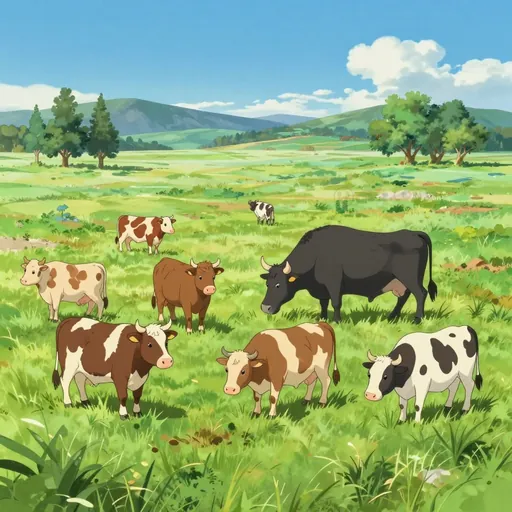
Noun: A taxonomic grouping within the subfamily Bovinae, essentially coextensive with the genus Bos. This term refers to a tribe of large, cloven-hoofed ruminant mammals, including domestic cattle, yaks, bison, and related wild species.
The term "tribe Bovini" is used in biological and zoological classification to categorize a specific lineage of bovids. It is not a technical term in everyday language but is standard in scientific contexts like taxonomy and evolutionary biology.
- In the taxonomic hierarchy, the tribe Bovini falls under the subfamily Bovinae.
- The evolutionary history of the tribe Bovini is studied through genetic analysis.
- Domestic cows () and water buffalo () belong to different tribes; the former is in tribe Bovini.
- Phylogenetic Context: The monophyly of tribe Bovini is supported by molecular data, distinguishing it from other tribes like Tragelaphini (spiral-horned antelopes).
- Morphological Traits: Members of the tribe Bovini often share characteristics like large body size and non-branching horns.
- Bovine (adjective): Pertaining to cattle or the subfamily Bovinae.
- Bovine diseases can impact livestock economies.
- Bovinae (noun): The subfamily containing the tribe Bovini and other tribes.
- Bos (noun): The genus name for cattle and oxen, which is core to this tribe.
- Cattle tribe (informal descriptive synonym)
- Bos tribe (more precise informal synonym)
The definition specifies "term not used technically; essentially coextensive with genus Bos." This indicates that in many practical classifications, especially non-technical ones, the scope of "tribe Bovini" is treated as nearly identical to the genus Bos, which includes domestic cattle, yaks, and bison. However, some taxonomic systems may include the genus Bubalus (water buffalo) within this tribe, showing slight variation.
-
term not used technically; essentially coextensive with genus Bos
Khám phá thêm
Các từ liên quan
Từ đồng nghĩa